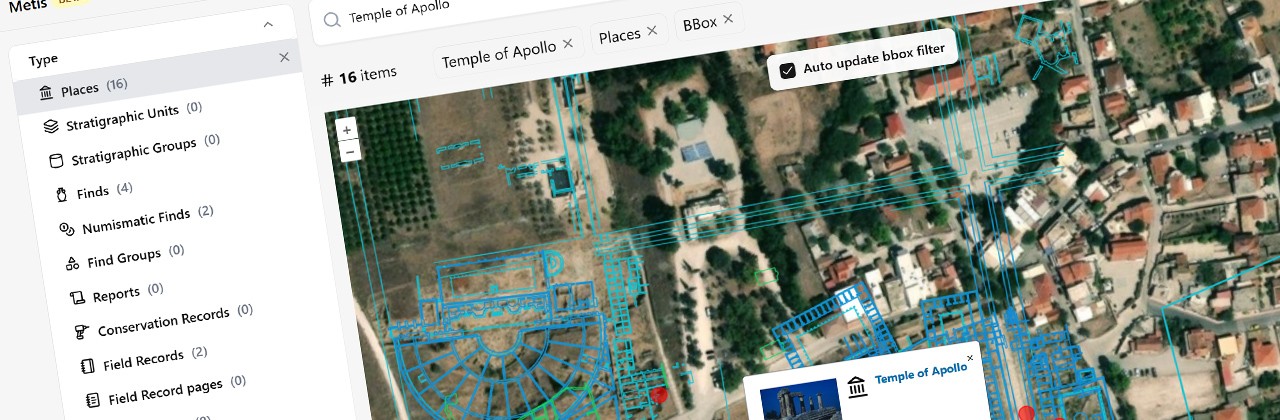
About Metis: ASCSA Archaeological Database
Metis: the ASCSA Archaeological Database brings together the digital archives of the Corinth Excavations in a single searchable interface, which includes a GIS base map. All resources are made available free of charge for teaching and research purposes.
Some material is password protected, including excavations at the Sanctuary of Demeter and Kore, the Gymnasium, and the East of Theater excavations. Unpublished material from Corinth outside of these projects is open to the public.
Digitization and Funding
Large portions of the collection were first digitized in 2007, co-funded by the Office of Regional Development of the European Union and the Greek State through the Operational Program "Information Society" of the 3rd Community Support Framework, with additional support from the Andrew W. Mellon Foundation. In 2009 the Samuel H. Kress Foundation generously funded the cataloging of our Numismatic Study Collection. More recently over 200,000 additional items have been digitized through the Operational Program "Digital Transformation" of the NSRF 2021–2027, co-funded by the European Union and the Greek State.
DATA TYPES with CIDOC CRM and traditional term
|
Metis Term |
Corinth Term |
CIDOC CRM |
|---|---|---|
|
area, monuments |
E53 Place, E27 Site |
|
|
baskets (before 2007), contexts (2007 to present) |
CRMarchaeo A8 Stratigraphic Unit |
|
|
deposits |
CRMarchaeo A8 Stratigraphic Unit, E25 Human-Made Feature |
|
|
objects |
E22 Human-Made Object, E20 Biological Object |
|
|
coins, tokens, jetons |
E22 Human-Made Object |
|
|
lots |
CRMarchaeo A1 Excavation Processing Unit |
|
|
excavator summaries, director reports |
E31 Document |
|
|
notebooks, bound loose leaf sheets, registers |
E31 Document |
|
|
notebook pages, loose leaf sheets, register entries |
E31 Document |
|
|
index cards for objects, coins, and deposits |
E31 Document, E13 Attribute Assignment |
|
|
E11 Modification |
||
|
volumes, books, articles |
LRMoo F19 Publication |
|
|
architectural drawings, maps, georeferenced images, orthophotos, DEM’s, GIS data |
E36 Visual Item, D1 Digital Object (CRMdig) |
|
|
photographs, scanned film negatives, video, 3D imagery |
D1 Digital Object (CRMdig) |
DESCRIPTIONS:
PLACES (monuments, areas) Named spatial entities that form the geographic and architectural framework of the excavation. Encompasses ancient and modern settlements, districts, and neighborhoods; excavation areas; ancient monuments and buildings; and natural and administrative geographic features. The traditional database term at Corinth Excavations is Area. Corresponds to CIDOC CRM E53 Place and E27 Site.
STRATIGRAPHIC UNITS (baskets, contexts) The smallest individually recorded excavation unit, representing a discrete depositional or constructional event. Each unit captures a single stratigraphic episode and forms the primary building block of the Harris Matrix sequence.
Stratigraphic units at Corinth Excavations include baskets and contexts. Until 2007, baskets were recorded in notebooks using various stamps to standardize fields. Context were first implemented in 2007 using a modified MoLAS system with (subtypes) deposit, structure, cut, and skeleton. Contexts were first recorded on loose leaf preprinted sheets and from 2018 to presents using the iDig app for iPads. Corresponds to CRMarchaeo A8 Stratigraphic Unit.
STRATIGRAPHIC GROUPS (deposits) Interpreted archaeological entities comprising one or more stratigraphic units that together constitute a coherent physical event or installation — such as a well, cistern, pit, grave, or robbing trench. Stratigraphic Groups represent a higher order of stratigraphic interpretation and serve as the primary unit for closed-context ceramic and chronological study. Subtypes carry the traditional Corinthian vocabulary (deposit, well, cistern, pit, grave, robbing trench, etc.). Corresponds to CRMarchaeo A8 Stratigraphic Unit and CIDOC CRM E25 Human-Made Feature.
FINDS (objects) Objects and materials recovered during excavation and individually inventoried, including pottery, sculpture, inscriptions, architectural elements, lamps, small finds, and ecofacts such as faunal remains and botanical samples. Corresponds to CIDOC CRM E22 Human-Made Object and E20 Biological Object.
NUMISMATIC FINDS (coins, tokens, jetons) Coins, tokens, jetons, and related monetary objects treated as a distinct find category due to their particular chronological, economic, and numismatic significance. Corinth based their initial database on the American Numismatic Society system beginning in 1988 and have continued to follow the ANS Nimisma. Corresponds to CIDOC CRM E22 Human-Made Object.
FIND GROUPS (lots) Administrative groupings of material remains representing a single archaeological event, episode of activity, or collection unit. Find Groups typically derive from one or more stratigraphic units but may also comprise material recovered without stratigraphic context, including surface collections, previously excavated material retained for study, and assemblages of intrinsically significant, unusual, or unique finds. Find Groups are the primary unit of material storage. Corresponds to CRMarchaeo A1 Excavation Processing Unit.
REPORTS (excavator summaries, director reports) Documentary records produced during excavation and research, including seasonal excavation summaries, area supervisor reports, specialist analyses, and conservation assessments. Subtypes distinguish excavation reports, conservation reports, scientific analyses, and other report categories. Corresponds to CIDOC CRM E31 Document.
FIELD RECORDS (notebooks, bound loose leaf sheets and registers) Primary field documentation produced during excavation, recording observations, stratigraphic interpretations, find references, and sketches. Subtypes include excavation notebooks, loose leaf recording sheets, field sketches and plans, and field registers. Corresponds to CIDOC CRM E31 Document.
FIELD RECORD PAGES (notebook pages, loose leaf sheets and registers) Individual entries within field records, representing a discrete page, sheet, or register entry produced during excavation. Subtypes reflect the parent document type: notebook page, loose leaf sheet, register entry. Corresponds to CIDOC CRM E31 Document.
INVENTORY RECORDS (object, coin, deposit index cards) Administrative records documenting the formal registration of finds, numismatic finds, and stratigraphic groups into the inventory system. Originated as physical index cards and capture attributes including description, dimensions, material, condition, findspot, and storage location at the time of recording. Subtypes include object card, coin card, deposit card, and deposit index. Corresponds to CIDOC CRM E31 Document, with attributes recorded as instances of E13 Attribute Assignment.
CONSERVATION RECORDS document the examination, treatment, and condition history of finds, architectural elements, and other excavated material. Includes pre- and post-treatment condition descriptions, treatment processes, conservator information, and associated images. Corresponds to CIDOC CRM E11 Modification.
PUBLICATIONS (volumes, books, articles) Formally published results of excavation and related research, including monograph series, journal articles, and exhibition catalogues. Corresponds to LRMoo F19 Publication.
SPATIAL DOCUMENTS (architectural drawings, maps, georeferenced images) Graphic and spatial records that document the physical and geographic dimensions of excavation. Includes architectural plans, stratigraphic sections, topographic maps, georeferenced orthophotos, DEMs, and georeferenced 3D models in which spatial location and relationship are the primary content. Corresponds to CIDOC CRM E36 Visual Item and D1 Digital Object (CRMdig).
MEDIA (photos, video, 3D, etc.) Visual and dimensional surrogates of excavated finds, features, and contexts in which the documentation of the subject itself — rather than its spatial position — is the primary purpose. Includes photographs, videos, and 3D models of portable finds and displaced architectural members. Corresponds to CIDOC CRM D1 Digital Object (CRMdig).