ASCSA Logo
ASCSA
Nobel Laureate George Seferis and his wife.

Archival Collections

The archival collections are presented alphabetically according to the name of either the donor or the subject of each collection. Dates of birth and death are given next to the heading of each entry, providing some evidence for the date of the material contained within. The main entry consists of a concise description of the contents of each collection (type and category of documents) as well as references to any offices held, or activities in which the subject participated. 

LIST OF COLLECTIONS

Ali Pasha (1744-1822)

David Balfour (1903-1909)

Loukas Bellos (1848-1913)*

Nikos Chatzikiriakos-Ghikas (1906-1995)

George Constantin (1833-1891)

Eugene Dalleggio (1888- )

Dragoumis Family

Odysseus Elytis (1911-1996)

Amvrosios (1869-1953) and Ioannis (1909-84) Frantzis

George Gennadius (1786-1854)

Johannes Gennadius (1844-1932)

Demetrios Kapetanakis (1912-44)

Konstantinos D. Karavidas (1890-1973)

Vasilis Kazantzis (-)

George Kastriotis (1910-1969)

Andreas Kordellas (1836-1909)

Nikolaos G. Mavris (1899-1978)

Dimitris Mitropoulos (1896-1960)

David Richard Morier (1784-1877)

Konstantinos Mousouros (1807-1891)

Michalis Myridakis

Stratis Myrivilis (1892-1969)

Dimitris P. Petrokokkinos (1861-1941)

Elias Petropoulos (1928-2003 )

Panayiotis Pipinelis (1899-1970)

Kleon R. Rangavis (1842-1917)

Konstantinos Sathas (1847-1914)

Heinrich Schliemann (1822-1890)

George Seferis (1900-1971)

Stephanos Skouloudis (1838-1928)

Skouze-Grypari Family

Athanasios Souliotis-Nikolaidis (1878-1945)

Bayard Stockton (1930-2006)

Dorothy H. Sutton

Angelos Terzakis (1907-1979)

Spyridon Theotokis (1876-1940)

Emmanuel I. Tsouderos (1882-1956)

Theodore Vavayianis ( 1905-1988)

Demetrios Vikelas (1835-1908)

Thomas Hewett Waterman (1846-1921)

William Aigner Wigram (1872-1953)

Ali Pasha (1744-1822)

Ali Pasha was an Albanian brigand, who became Pasha of Ioannina, and extended his rule over much of Albania, Macedonia, Epirus, Thessaly, and the Morea. In Ali Pasha’s time, Ioannina became the foremost center of Greek culture. He employed many Greeks and founded Greek schools. 

This significant collection, which concerns the period of Turkish occupation, Ali Pasha of Ioannina, and his sons Veli and Muhtar Pasha, consists of 1500 public and private documents, about religious, legal, financial, community, administrative and family matters, as well as various military campaigns (1802-1820). 

Quantity: 1.40 linear meter. 
Gift of Damianos Kyriazis, 1953. 

David Balfour (1903-1989)

David Balfour was a priest-monk in the Russian Orthodox Church, a member of the British Intelligence Service, a diplomat, and a Byzantine scholar. 

The collection consists of thirty -nine letters in Russian written during 1932-1936 and 1945-1947 by Father Sophrony to David Balfour, as well as copies of letters of David Balfour to Father Sophrony. 

Quantity: 0.22 linear meter. 
Gift of Louise Balfour, 1993. Restricted access. 

Loukas Bellos (1848-1913)

Loukas Bellos, a doctor from Boeotia and a Member of the Greek Parliament, also became known for his newspaper articles on linguistic subjects (Greek and Albanian languages). From 1874 to 1878, Bellos published the newspaper "Boeotia." The collection consists of medical treatises, journals, ledgers and notes, printed treatises and articles on linguistic subjects (Greek and Albanian languages), political speeches, letters, poems, correspondence, and photographs.

The collection also includes a bound copy of all issues of the newspaper "Boeotia"

Quantity: 0.90 linear meter. 
Gift of Antigone Threpsiadou-Bellou, 1990. 

Nikos Chatzikiriakos-Ghikas (1906-1995)

The painter Nikos Chatzikiriakos-Ghikas donated to the Library small part of his papers which includes the manuscript of his Greek translation of "The Courtship of the Yonghy-Bonghy-Bo," by Edward Lear, parts of his French translation of the Odyssey by Nikos Kazantzakis, a manuscript of Odyssey’s translation by Robert Levesque, and notes by Kimon Friar concerning the English translation of Kazantzakis’ Odyssey. In addition, the collection includes thirty-five original drawings by Ghikas created for the publication of the Odyssey, as well as thirteen original drawings concerning the publication of Poems, 1896-1933, by C. Cavafy. 

Quantity: 0.30 linear meter
Gift of Nikos Chatzikiriakos-Ghikas, 1973

George Constantin (1833-1891)

See Watermann, Thomas Hewett

Eugene Dalleggio (1888- )

Eugene Dalleggio served as an officer at the Instruction Publique of France and was a member of both the French Institute of Byzantine Studies in Paris and of the Center of Asia Minor Studies of the French Institute in Athens. Dalleggio also contributed to the organization of the Military Museum of Constantinople. During his life he traveled extensively in Asia Minor and the Black Sea, conducting archaeological and historical research in Bithynia and the Taurus Mountains in Cilicia. He published several articles on the topography and history of Constantinople. 

The collection consists of personal notes concerning the research and publication of Karamanlidika (Karamanlidika. Bibliographie analytique d’ouvrages en langue turque imprim’s en caract’res grecs, Athens 1958), manuscript books written in Karamanlidika, old photos of Constantinople and other cities in Asia Minor, etc. 

Gift of Mario Dalleggio, 1989

Dragoumis Family

An important family in the political and intellectual life of Greece in the 19th and 20th centuries. The collection consists of the papers of Markos Ath. Dragoumis (1770-1854), Nikolaos N. Dragoumis (1809-1879), Euphrosyne N. Dragoumis (1818-1915), Markos N. Dragoumis (1840-1894), Marika N. Dragoumis (1846-1941), as well as copies of letters of Count Arthur de Gobineau to Zoe and Marika Dragoumis ("Gobineau Collection"). See also finding-aid: Chr. Varda and Voula Konti, The Papers of the Dragoumis Family (in Greek), Athens: Gennadius Library, 1991

Quantity: 7.47 linear meters. 
Gift of Phillipos St. Dragoumis, 1960. 

Markos Ath. Dragoumis (1770-1855)

Trained as a teacher, Markos A. Dragoumis served as a Secretary to the Moldavian leaders Constantine Ypsilantes (1799-1802) and Skarlatos Kallimaches (1805). In 1805, he was appointed Governor of the Aegean Islands before returning to Constantinople to continue his career as a teacher. In 1812, he served as a Secretary to the Moldavian leader Ioannis Karatzas. He became a member of the Philike Etaireia in 1820 and during the War of Independence worked to organize the newly established Greek State. He was married to Zoe Sofianou-Deligianni and had two children, John (1807-1872) and Nikolaos (1809-1879). 

The collection consists of correspondence, manuscripts, bills, and secondary material referring to his work.. 

Quantity: 0.14 linear meter. 

Nikolaos M. Dragoumis (1809-1879)

Son of Markos Ath. Dragoumis, Nikolaos M. Dragoumis held many public offices in the newly established Greek state, including positions in the Ministry of Foreign Affairs and the Ministry of Nautical Affairs, where he acted as a consultant. in addition to his governmental positions, he worked as a journalist for the newspaper "Aion" and was editor of the periodical "Pandora" from 1855 to 1872.  He was active on the social forefront and founded many societies, such as the "Society of the Friends of the People"and the "Philekpaideutike Etaireia." He was married to Eufrosyne Georganta and had four children, Markos (1840-1809), Stephanos (1842-1923), Zoe (1843-1894) and Marika (1846-1941). 

The collection consists of official public documents relating to the government offices he held, correspondence about various institutions and societies, correspondence and documents relating to the periodical "Pandora", newspapers, newspaper clippings, and photos. 

Quantity: 1.70 linear meter. 

Euphrosyne N. Dragoumis (1818-1915)

Born in Constantinople and the daughter of a merchant, Stephanos Georgantas, Euphrosyne lived the early years of her life in Odessa attending the "Ecole de Noblesse." In 1831 she moved to Nauplion and later to Athens where she married Nikolaos Dragoumis (see above) in 1839 and had four children, Markos (1840-1809), Stephanos (1842-1923), Zoe (1843-1894) and Marika (1846-1941).  Euphrosyne Dragoumis was one of the founding members of the Amalieio Orphanage, and member of many other welfare organizations. 

The collection consists of family correspondence, and personal papers. 

Quantity: 0.28 linear meter. 

Markos N. Dragoumis (1840-1909)

Markos N. Dragoumis studied law in Paris (1857-1862) and wrote his dissertation on De la condition civile de l’etranger en France (Paris 1864).  He then embarked upon a diplomatic career with posts in Paris(1861-1863), St. Petersburg (1867-1871, 1887-1890), Vienna (1874-1877), Alexandria (1877-1880) and Bucharest (1880, 1882-1885). He participated in many committees, such as the Committee for the Olympic Games (1895) and the Committee for the National Gallery (1906-1907), and wrote essays for the Bulletin d’Orient (1903-1908). He was married to Eliza Novikoff. 

The collection consists of official documents relating to his public service, legal documents, letters pertaining to the committee for the erection of the statue of Constantine Palaeologos, correspondence (family, Bulletin d’Orient, clubs, organizations), personal papers, periodicals, newspapers, and photographs. 

Quantity: 1.40 linear meter. 

Eliza M. Dragoumis (1843-1904)

Eliza Dragoumis, born Novikoff, was the wife of Markos N. Dragoumis (see above). 

The collection consists of family correspondence, photographs, and secondary post-mortem material (1936, 1959, 1967). 

Quantity: 0.83 linear meter. 

Zoe N. Dragoumis (1843-1894)

Zoe Dragoumis was the daughter of Nikolaos and Eufrosyne Dragoumis. At a young age she went to Paris and received, together with her sister Marika, an artistic education which involved painting and music.  In 1864, she and her family became acquainted with Count Joseph Arthur de Gobineau, the Ambassador of France to Greece (1864-1868) with whom they corresponded for almost two decades [see Comte de Gobineau, lettres a deux Atheniennes (1868-1881). Introduction de Madame N. Mela, Athens 1936]. 

The collection consists of family correspondence, various documents (bills, awards, notebooks, photographs), and drawings. 

Quantity: 0.68 linear meter.
 

Marika N. Dragoumis (1846-1941)

Marika N. Dragoumis was the youngest child of Nikolaos and Eufrosyne Dragoumis. She studied painting and music in Paris and became an accomplished musician. She also served as a member of several welfare organizations and literary societies. 

The collection consists of documents relating to her social work, family correspondence, journals, drawings, and newspaper clippings. 

Quantity: 1.35 linear meter. 

Gobineau Collection

The collection consists of typescript copies of the letters of Count Joseph Arthur de Gobineau to Zoe and Marika Dragoumis, papers concerning the publication of the Gobineau letters, periodicals, and newspapers. The original letters of Count Joseph Arthur de Gobineau are in Paris, at the Bibliotheque Nationale. 

Quantity: 0.53 linear meter. 

Stephanos N. Dragoumis (1842-1923)

Stephanos N. Dragoumis, the son of Nikolaos and Eufrosyne Dragoumis, became an important political figure in late 19th/early 20th century Greek history.  He served as Prime Minister (1910), Minister of Foreign Affairs (1886-1890, 1892-1893), Governor of Crete and Macedonia (1912-1913), Minister of Finance (1915-1916), and Member of the Parliament (1879-1895, 1899-1910, 1915, 1920).  As a close friend of Charilaos Trikoupis, he participated in Trikoupis’ plans for the economic development of the Greek state. He married Eliza Kontogiannaki and had eleven children, Natalia (1872-1973), Nikos (1874-1933), Efi (1875-1964), Charikleia (1876-1966), Ion (1878-1920), Alexandra (1880-1976), Zoe (1882-1964), Markos (1884-1888), Marika (1886-1939), Philippos (1890-1980), and Alexandros (1891-1977). 

The collection consists of official documents; notes and correspondence relating to his political activities, as well as his philological and archaeological interests; family correspondence; medals and awards, and photos. The researcher will find information about several important issues of Greece’s foreign policy during the late 19th/early 20th century, such as the Bulgarian and Roumanian issues (e.g., the Zappa case), the Albanian/North Epirus problem, and the Cretan and Macedonian questions. 

Quantity: 18 linear meters. 

Philippos St. Dragoumis (1890-1980)

Philippos St. Dragoumis was one of the many children of Stephanos and Eliza Dragoumis. He served as a diplomat, Member of Parliament, Minister and High Commissioner of Macedonia, Vice-Minister of Foreign Affairs, Minister of Defense, and Minister of Foreign Affairs. He was also the author of several political treatises. 

The collection consists of official documents and papers relating to the public offices he held; various documents relating to the Macedonian Struggle and the Macedonian Question, Greek-Albanian relations, and the Cypriote Question; personal notebooks; personal and family correspondence; awards; photographs; biographical information related to the Dragoumis family history, and newspaper clippings about Philippos Dragoumis.  Catalogue: Chr. Varda, Archeio Philippou Dragoumi (1890-1980). Eureterio, Athens: Gennadius Library, 1993. 

Quantity: 11 linear meters.

Ion St. Dragoumis (1878-1920)

Ion Dragoumis, one of the many children of Stephanos and Eliza Dragoumis, played a central role in the Greek politics of the early 20th century. He served initially as a diplomat in Istanbul, Rome and St. Petersburg and worked with a passion for the annexing of Macedonia to the Greek state. He was elected a Member of the Greek Parliament (1915), but was soon exiled to Corsica (1917) and to the island of Skopelos (1919) after coming into conflict with Eleutherios Venizelos. He was assassinated by his political opponents in Athens in 1920. 

The processed part of the collection consists of correspondence arranged in alphabetical order. The rest of the collection consists of official correspondence relating to his diplomatic and other state positions together with documents relating to issues of foreign affairs such as the Macedonian Issue, the Greek relations with other countries and nations of the Balkan Peninsula, and the Greek-Turkish relations. Drafts of his various publications, newspaper clippings and photographs are also included. 

The personal correspondence is fully catalogued and accessible. The catalogue is available in Greek and now in English. 

Quantity: 7.70 linear meters. 

Odysseus Elytis (1911-1996)

Odysseus Elytis, a well-known poet, was awarded the 1979 Nobel Prize for Literature by the Swedish Academy. The Academy wrote that "his poetry against the background of Greek tradition depicts with sensuous strength and intellectual clear sightedness modern man’s struggle for freedom and creativeness." His first collection of poems, entitled Orientations, was published in 1940.  His next important poetic collection and what is still considered his magnum opus, The Axion Esti, appeared in 1959. Selected sections of this work was set to music by Mikis Theodorakis. In the early 1970’s, Elytis published several collections of poems, such as The Light-Tree and the Monogram in 1971, The Sovereign Sun and the Rhos of Eros in 1972.  A year before he received the Nobel Prize, Maria Nepheli was published. After receiving his Nobel Prize, Elytis continued publishing poetry and prose until his death; Three Poems under a Flag of Convenience (1982), The Little Seafarer (1985), The Elegies of Jutting Rock (1991), and West of Sorrow (1995), to mention some of his post-Nobel work. 

The collection consists of correspondence, manuscripts, collages, drawings, publications and studies of Elytis’ work, posters, invitations, catalogues of publishing houses, pamphlets, record albums of his poetry put to music, tapes of lectures and interviews, newspaper clippings, photographs, books with handwritten dedications to the poet, etc. 

Quantity: 8.50 linear meters. 

Gift of Odysseus Elytis, 1976. 

Amvrosios (1869-1953) and Ioannis (1909-1984) Frantzis

Amvrosios Frantzis, an army officer and descendant of a well-known Byzantine family, served as a diplomat in Istanbul and Sofia (1910-1912), and was a close partner of Prime Minister Eleutherios Venizelos. He participated in the Greek- Turkish War of 1897, the Goudi Military League (1909), and the Balkan Wars. From 1917 to 1922 he served as military attache at the Greek Embassy in London. In 1926 he was appointed military attache to the Prime Minister Kountouriotis. 

Ioannis Frantzis, son of Amvrosios, served as a diplomat in the Greek Embassies of Albania and Egypt before being appointed Director of the Political Office of Prime Minister George Papandreou (1944), and later, in the service of Prime Minister K. Tsaldaris. In 1947, Ioannis Frantzis served as diplomat in Praetoria and the following year in Washington, D.C. From 1950 to 1953 he served as Head of the Diplomatic Office of the Ministry of Foreign Affairs. From 1953 to 1958 he was Councellor and Head of the Press Office of the Greek Embassy in London. From 1959 to 1964 he was appointed to the Ministry of Foreign Affairs and from 1965 to 1967 he was Greece’s ambassador to India. 

The collection consists of political, diplomatic and personal papers and correspondence, including letters of Alexandros Stourzas. The collection also contains letters from Eusebius Panas to Konstantino Oikonomou (1824-1855) concerning the Orthodox Church. The collection is partly processed. 

Quantity: 3.02 linear meters
Gift of K. Psimmenos, 1985. 

Giannis Galanos (Panitsas) (-)

Twenty-eight (28) diaries of the poet Giannis Galanos, a pseudonym of Giannis Panitsas. The diaries are dated in 1954- 1963, and contain information concerning his stay in London, as student of Medicine and in Athens, where he studied Law. 

Quantity: 1 box
Gift of Giannis Panitsas, 1978. 

George Gennadius (1786-1854)

Educational writings by George Gennadius, scholar and "teacher" of the nation. Official documents of the Ministry of Religion and Education as well as responses by Gennadius concerning educational matters. Private correspondence. 

Quantity: 0.75 linear meter. 
Gift of John Gennadius, 1926. 

John Gennadius (1844-1932)

Personal correspondence of the founder of the Gennadius Library, bibliophile and diplomat, papers and official documents relating to personal, family, political, religious and educational matters. Notes on various subjects relating to his interests and occupations; translations. 

Quantity: 3 linear meters. 
Gift of John Gennadius, 1926. 

Demetrios Kapetanakis (1912-44)

Manuscripts (essays, poems), personal papers (passport, notes), correspondence, particularly with John Lehmann (1940-44), publications on Kapetanakis, newspaper clippings. 

Quantity: 0.35 linear meter. 
Gift of John Lehmann, 1977. 

Konstantinos D. Karavidas (1890-1973)

Konstantinos Karavidas served for years in the Agricultural Bank of Greece and is known for his contribution to the modernization of agriculture in Greece. Before joining the Agricultural Bank in 1932, he served as a high-rank officer in the Ministry of Foreign Affairs (1915-1917). He is also the author of several treatises on agricultural matters; publisher of the periodical "Koinotes"(1922-1924); and author of several works of literature.  The collection consists of official documents; memoranda; treatises and newspaper clippings pertaining to Macedonia and the works of the Agricultural Bank (i.e. land reclamation, loans); personal correspondence and literary manuscripts; periodicals; and newspapers. The collection is partly processed (Catalogue: M. Korasidou and D. Samiou, "To Archeio tou Konstantinou D. Karavida (1890-1973)", The New Griffon, v. 3, 1992, pp. 8-12.)

Quantity: 12 -15 linear meters. 
Gift of Zoe Kalliga-Karavida, 1987-1990. 

George Kastriotis (1910-1969)

Sculptor, a student of the famous 20th century classicist sculptor Emile-Antoine Bourdelle and a graduate of the Acadèmie de la Grande Chaumière. He lived most of his life in Athens . He exhibited in Athens, Paris, Stockholm and Copenhagen. 

Kastriotis was also the nephew and godchild of Sophia Schliemann. His family correspondence contains letters of Sophia Schliemann and other members of the Kastromenos and Pavlidis families. His papers contain also personal documents, newspaper clippings, artistic drawings, drafts and blueprints of mechanisms he invented and designed.

Quantity: 0.60 linear meter
Gift of Mary Kastrioti. 

Vasilis Kazantzis (-)

Letters from prominent Greek literary figures (e.g., Elytis, Kakridis, Karagatsis, Papanoutsos, Seferis, Theotokas, Venezis) to Vasilis Kazantzis, translator and staff member of the British Council. Also one letter from Andreas Papandreou. Letters to members of the Kazantzis family (1899-1901). 

Quantity: Nineteen (19) letters. 

Andreas Kordellas (1836-1909)

Mineralogist and Professor of Geology and Mineralogy in the Greek Military Cadet School. He was the first to notice and study the possibility of exploitation of the ancient lead mines of Laurion. His scientific work and the reports he submitted to the Ministry of Finance formed the basis for the first laws concerning the mining enterprise of Modern Greece. From 1864 to 1873, he worked as a Product Engineer in the French-Italian mining company Roux-Serpieri-Fressynet C.E. During the years 1877-1879 he conducted research on the hydraulic system of Attica. Finally, he served as Director of the Greek Mining Company (1887-1891). 

Quantity: 0.50 linear meter. 
Gift of Eleni Kordella, 1996.

Nikolaos G. Mavris (1899-1978)

Nikolaos Mavris studied medicine while pursuing his interests in literature and law. Just before World War II, Mavris settled in the United States where he founded the "National Dodecanesian Council". In 1948, after his return to Greece, Mavris was elected First General Governor of the Dodecanese and later became a Member of the Greek Parliament. His work on the bibliography of the Dodecanese was awarded the first prize by the Academy of Athens.  The collection consists of documents, periodicals, and local newspapers, relating to the history newspapers relating to the history and administration of the Dodecanese (especially the function of the National Dodecanesian Council), as well as material pertaining to the establishment of the Greek Bibliographic Society. The collection is partly processed.

Temporary catalogue of contents (in Greek). The processing of the collection is near completion. 

Quantity: 15.30 linear meters (catalogued). 
Gift of the Mavris heirs, 1988. 

Dimitris Mitropoulos (1896-1960)

Dimitris Mitropoulos, a world-known conductor, served as the director of the Symphony Orchestras of Boston (1936-1938) and Minneapolis (1938-1949), as well as of the Philarmonic Orchestra (1949-1950) and the Metropolitan Opera in New York. 

The collection includes handwritten sheet music of his works for the piano, songs, chamber music, works for orchestra, opera, etc; correspondence (1933-53), letters to his friend Kaiti Katsoyanni (1920-60); collections of newspaper clippings and interviews; musical reviews of his work as a composer and a conductor; programs of orchestral performances (Minneapolis Symphony Orchestra, New York Philharmonic Orchestra, Metropolitan Opera); photographs, audio tapes, etc.

Quantity: 3.20 linear meters
Gift of Kaiti Katsoyanni and James A. Dixon, 1963. 

David Richard Morier (1784-1877)

David Richard Morier was an English diplomat who served in Egypt, the Dardanelles, and Constantinople. He also authored "Photo the Suliot, a Tale of Modern Greece", 1857. 

The collection consists of the correspondence of Demetrios Shkinas, a copy of a letter of Adamantios Koraes to George Shkinas, and a manuscript of "Rosso-Anglo-Gallos," one of the oldest novels in the history of Greek literature. 

Quantity: 0.1 linear meter. 

Konstantinos Mousouros (1807-1891)

Konstatinos Mousouros, a Greek by birth and culture but a Turkish subject, served as the ambassador of Turkey to Greece (1840-1847). He remained in Athens until the famous "Mousouros incident" in 1847 which brought a temporary break in diplomatic relations between the two countries. From 1851 to his retirement in 1885, he was Turkish ambassador in London where, for many years, he and John Gennadius were diplomatic colleagues and friendly rivals. 

The collection consists of official documents relating to state affairs of the Ottoman Empire with Greece and other European countries. The most important section is the correspondence between Mousouros and his father-in-law Stephanos Vogoridis, Governor of Samos, where he gives an almost day-by-day account of all that was taking place there during the crucial period of the early Kingdom of Greece. 

Quantity: 2.10 linear meters. 
Bought from G. Patriarcheas, 1971-73. 

Michalis Myridakis

Michalis Myridakis served as an officer in the Greco-Italian War (1940-1941). During the Greek Civil War (1945-1949), he joined the Greek National Democratic Army. Myridakis has authored several books on the Greek Civil War. 

Copies (originals are kept in the General State Archives[GAK]) of documents, letters and notebooks relating to his activity in the E.D.E.S. ( Greek Democratic National Army) and N. Zervas during the Greek Civil War. 

1 folder, 33 documents. 
Gift of Michalis Myridakis, 1989. 

Stratis Myrivilis (1892-1969)

Stratis Myrivilis is perhaps mostly known for his novels Life in the Tomb (1930), The Schoolmistress with the Golden Eyes (1933) and Vasiles (1943), novels widely read and very popular among generations of Greek readers. The bulk of his writings, however, consisted of newspaper articles (chronographemata) and texts for his radio programs, evidence that sheds light to another side of Myrivilis, that of an active journalist and broadcaster. 

Born on the island of Mytilene in 1892 he died in Athens in 1969 and lived through such sweeping events as the wars of the first half of the 20th century, the liberation of his native island, the rebellions and disillusionment, the despair and hope that followed World War II. No wonder so many of his stories are dominated by conflicting emotions and powerful contrasts. An ardent young patriot, who twice volunteered for war service and fought in the Balkan Wars, the campaign to Asia Minor, and also served as a reporter at the Albanian front, Myrivilis was no less a revolutionary idealist, a supporter of demotike and a pro-Venizelist, eventually to become known as one of the greatest prose writers of modern Greece. 

The collection consists of personal documents, manuscripts, papers delivered on various occasions, correspondence, newspaper clippings and a press collection, including newspapers that Myrivilis himself published or directed and underground press that circulated during the German Occupation. 

Quantity: 4.20 linear meters
Gift of Kaiti Myrivili, Haris and Eleni Myrivili and Drosoula Angelopoulou, 1999. 

Dimitris P. Petrokokkinos (1861-1941)

Catalogue: V. Kalantzopoulou, Archeio D. Petrokokkinou (1861-1941), The New Griffon, v. 3, 1992, pp. 3-7. 

Letters and postcards written from Y. Psycharis (1900-20), P. Vlastos (1920-40), and I.N. Mavrkordatos (1932-40) to Petrokokkinos regarding literary, linguistic and publishing issues; bills, receipts, and catalogues. 

1 folder. 
Gift of the heirs of D.P. Petrokokkinos, 1944. 

Elias Petropoulos (1928-2003)

Elias Petropoulos is well-known from his books on the "rebetika" music, the Greek "underworld," the traditional Greek art, etc. The collection includes his correspondence, original drawings by the author and other well-known Greek painters used for the illustration of his books, handwritten sheet music and lyrics of 1250 rebetika songs, photographs of musicians and singers, musical instruments, and other objects. See also finding-Aid: The Papers of Elias Petropoulos (in Greek), Athens: Gennadius Library 1996; and Natalia Vogeikoff, "The Papers of Elias Petropoulos," The New Griffon. New Series 1, Athens: Gennadius Library 1996. 

Quantity: 12 linear meters
Gift of Elias Petropoulos, 1974-2003. Gift of Mary Koukoule, 2008. 

Panayiotis Pipinelis (1899-1970)

Politician and Prime Minister of Greece. Pipinelis studied law and served for many years as a diplomat in various Greek embassies and as Ambassador to Budapest (1936) and Sophia (1940). He became Minister of Foreign Affairs in the period 1947-1950. In 1952, Pipinelis became the permanent representative of Greece in NATO. In 1963 he was appointed Prime Minister of Greece by Queen Frederika, a position which he kept for a short time. His political career is characterized by his devotion to the royal family. In addition to his political career, Pipinelis wrote several books on the political history of Greece, such as "The Political History of the Greek Revolution" (1928), "The History of the Foreign Policy of Greece" (1948), and "Greece’s International Position and Social Problems" (1956). 

The collection consists of political speeches, memoranda, interviews, and notes on issues of Greek internal and external affairs. 

Quantity: 0.15 linear meter. 
Gift of his widow, 1974. 

Kleon R. Rangavis (1842-1917)

Kleon Rizos-Rangavis was born in Athens in 1842 and died in Nice in 1917. After studying law in Berlin and Heidelberg, Rangavis served as diplomat in Washington, D.C., St. Petersburg, and Vienna, before being appointed Greece’s Ambassador to Sophia. Rangavis is especially known for his literary interests. 

The collection consists of manuscripts and translations of the author’s literary works, correspondence, newspaper clippings with reviews of his work, programmes, contracts, and posters. 

Quantity: 0.30 linear meter. 
Gift of Alexander Rizos-Rangavis, 1972. 

Konstantinos Sathas (1847-1914)*

Family correspondence, photographs of family members, etc. 

70 documents.
Bought from K. Vlasopoulos, 1969. 

Heinrich Schliemann (1822-1890)

The Heinrich Schliemann Papers contain diaries, correspondence, manuscripts, personal documents, photographs, economic documents and registers, expenditure books, scrapbooks, and newspaper clippings, which belonged to the famous German archaeologist and excavator of Troy and Mycenae. In addition to the Heinrich Schliemann Papers, there are two adjunct collections of papers, the Sophia Schliemann Papers and the Heinrich Schliemann Family Papers.

On the history of the Schliemann papers, see also S. A. H. Kennell, “Schliemann and his Papers: A Tale from the Gennadeion Archives,” Hesperia 76:4 (2007), pp. 785-817 [http://www.ascsa.edu.gr/index.php/publications/Hesperia/]; and D. F. Easton, "The Schliemann Papers," Annual of the British School of Archaeology 77 (1982), pp. 93-110. 

Quantity: 14.5 linear meters
Bought from Schliemann heirs, 1936, 1962-1966. 

George Seferis (1900-1971)

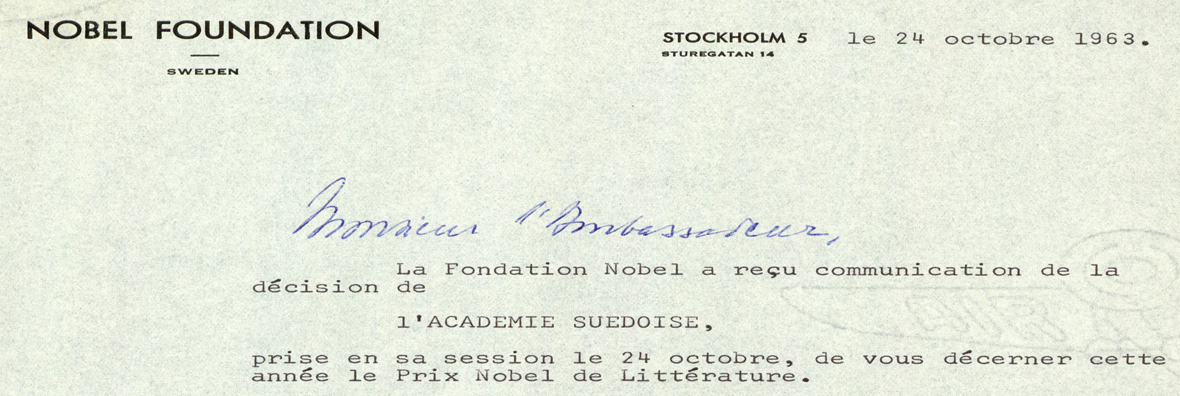
George Seferis was born in Smyrna in 1900 and moved to Athens when he was fourteen. He studied in Paris at the end of the First World War, before joining the Greek diplomatic service. From 1957 to 1962 he served as Greece’s Ambassador in London. His first collection of poetry, "Turning Point," was published in 1931. In 1963, George Seferis was awarded the Nobel prize for Literature. His poetic writings include three collections under the title "Log-Book" (I-III), "Novel", and "Three Street Poems." Seferis is part of the so-called "Generation of Thirties."

The collection contains manuscripts, translations of his works, documents pertaining to his career as a diplomat, correspondence (family, personal, congratulations on the Nobel Prize, obituaries, etc.), texts by friends and acquaintances, personal papers, awards, and newspaper clippings. See Table of Contents. 

Quantity: 10.80 linear meters. 
Gift of Maro Seferi, 1972, 1996. 

Stephanos Skouloudis (1838-1928)

Stephanos Skouloudis, a successful businessman and one of the co-founders of the Bank of Constantinople, became involved in Greek politics after he moved to Athens in 1876. With the outbreak of the Eastern Crisis Skouloudis was appointed as the Greek delegate in the negotiations with the Albanians. This was the starting point of a memorable political career. A close friend, political and personal, of Charilaos Trikoupis served in Trikoupis’ cabinets as Minister of Education, and Minister of Marine. Under Dimitrios Rallis’ government he served as Minister of Foreign Affairs. At the peak of his career, in the midst of the Great War and the big crisis in the Greek political scene with the severance in the relations of King Constantine and Eleftherios Venizelos, Skouloudis was summoned by the King to head the government for a short period of time (1915-1916). This was his last service to his country.  He died in August 19, 1928 in Athens. Skouloudis was an ardent lover of the arts and a very important collector. After his death he donated his collection of paintings to the National Gallery. He was also a philanthropist throughout his life. One of his most eminent donations was the creation of the Opthalmological Clinic at Baloukli in Constantinople. 

The papers include Skouloudis’ official correspondence, scrapbooks of press cuttings, and books from his private library. They provide a wealth of information for the political career of Skouloudis and modern Greek history in the last part of the 19th century and the first quarter of the 20th.  Skouloudis was the founder of the Lake Compais Company Ltd (1883), which undertook the project of the drainage of the Copais Lake in the late 19th century. 

Eleftheria Daleziou has prepared the finding-aid of the collection (a small part of the collection related to the Lake Copais was catalogued by researchers N. Melios and A. Papadopoulos in 1989). 

Quantity: 6.20 linear meters. 
Gift of G. Athenogenni, 1986. 

Skouze-Grypari Family

Panagis Skouzes (1776-1847), one of the first members of the Philike Etaireia, supplied the first Greek army with guns for the War of Independence of 1821, on his own expenses. Georgios Skouzes (1811-1884), son of Panagis, was originally involved in commerce in Trieste, but later participated in the establishment of the National Bank of Greece, the Ionian-Industrial Bank, and the Athens-Peiraeus Railway Company. 

The collection consists of legal and commercial documents of the Skouze commercial firm, notes on architecture, periodicals, and newspapers. 

Quantity: 0.10 linear meter. 
Gift of Marietta and Helen Grypari, 1962-63. 

Athanasios Souliotis-Nikolaidis (1878-1945)

Catalogue: Eleni Phournaraki, Archeio Athanasiou Soulioti-Nikolaidi. Athens: Gennadius Library, 1992. 

Athanasios Souliotis, an army officer who taught Geography in the Cadett Academy, participated in the Macedonian Struggle under the name Nikolaidis. In 1908, together with Ion Dragoumis, they established the so-called secret organization of Constantinople. Souliotis partcipated in the Balkan Wars and saved Thessaloniki by warning the Greeks of the impending invasion of the Bulgarians. In 1934, Souliotis was elected head of the Nome of Florina, while in 1935, he was elected General Commander of Thrace. 

The collection consists of personal correspondence; manuscripts (memoirs, historical treatises, literary texts); documents relating to the public offices Souliotis held; newspaper clippings; and a photographic collection of the Macedonian Struggle, the Balkan Wars, and the Campaign to Asia Minor. 

Quantity: 2.40 linear meters. 
Gift of Sophia Soulioti, 1973. 

Bayard Stockton (1930-2006)

American journalist, author of Phoenix with a bayonet; a journalis’s interim report on the Greek Revolution (1971). During the 1950’s he worked as officer in Berlin and in London while being a freelance reporter for Newsweek and BBC. In 1964 he moved to Greece being the Greek, Cyprus and Turkey correspondent of ABC Radio News and the West German Radio and TV. His papers contain information (correspondence, magnetic tapes, maps, and photographs) concerning the publication of Phoenix with a Bayonet and the creation of a film on the Battle of Crete in WW2. Stockton also collected information on the history of the famous Athenian hotel Great Bretagne. Returning to the U.S. in 1980, Stockton freelanced in San Francisco, mostly for British media, until he settled in Santa Barbara. There he was copy-editor on the Santa Barbara News-Press; and, for three years, Associated Press award-winning commentator, host and reviewer for a local radio station. 

Dorothy H. Sutton

Letters of Dorothy Sutton, member of the Near East Relief, from Constantinople, South Russia, Greece (Loutraki, Kephallonia, Syros, Thessaloniki) to her family in the United States, referring to what she and the Near East Relief were doing for refugees and orphans (1920-26). 

Quantity: 2 folders. 
Gift of Alice H. Schell, 1984. 

Angelos Terzakis (1907-1979)

Distinguished novelist and playwright Angelos Terzakis was one of the main representatives of the innovative ‘generation of the thirties’, an influential group of writers that opened new grounds in literary experiment in the 1930s. Terzakis’ interests lie between broader historical and moral issues, as well as traditional values and the agonizing questions that torment the individual. The words of one of his heroes, Michalis Paradisis in the novel Without a God, who talks about the feeling that he belonged to a generation that had been sacrificed probably reflect Terzakis’ own concerns. The settings of Terzakis’ novels range from contemporary urban life, to the historical past, to the 13th century Peloponnese . Princess Izambo (1938/1945) is the most widely known and translated of Terzakis’ novels. Other novels by Terzakis include Without a God (1951) and The Secret Life (1957). Terzakis also wrote short stories, essays and newspaper serials and translated into Greek plays, poems and novels. His first collection of short stories was published in 1925. His plays, including Thomas with Two Souls, have been produced both in Greece and abroad (United States and Germany), while his historical dramas Emperor Michael (1936) and Theophano (1948) made an impact when performed in the 1950s and again in the 1970s. Furthermore, Terzakis’ career is highlighted by his involvement in editing literary periodicals, writing theater criticism and philological essays in the newspaper Vima and teaching history of drama at the Drama School of the National Theatre of Greece. 

Terzakis also served as secretary and director of the National Theater of Greece for several years, as well as director of the Drama School of that institution. He was honored with various prizes and in 1974 he was elected a member of the Greek Academy of Arts and Sciences. 

The collection consists of manuscripts, personal documents, correspondence and newspaper clippings (chronological range: 1927-1978). The catalog (in Greek) has been prepared by Leda Costaki. 

Quantity: 4.26 m linear meters. 
Gift of Dimitris Terzakis, 2001. 

Spyridon Theotokis (1846-1940)

The papers of historian Spyridon Theotokis, brother of the novelist Konstantinos Theotokis, contain research material concerning his study of the history and genealogy of the Ionian Islands and Crete under the Venetian rule. Documents from the Records of the Ionian Senate, which Spyridon Theotokis directed from 1912 to 1935. 

Quantity: 1 folder. 
Gift of Th. Frangopoulos, 1968

Emmanuel I. Tsouderos (1882-1956)

Emmanuel Tsouderos studied law and economics. From 1906 on he was elected several times as a member of the Greek Parliament. From 1919 to 1929 he represented Greece in many international meetings on commercial, economical issues and on issues concerning the national debt. He served as Minister of Transportation (1924) and Minister of Economy (1924) before becoming Deputy President of the Bank of Greece (1925), and President (1931-1939), when he was dismissed by the Metaxas government. In April 1941 he was entrusted by King George II with the formation of a government which became the Greek government-in-exile during World War II. After the war he was appointed Minister of Coordination and Minister of Interior. 

The collection consists of official documents pertaining to foreign policy during World War II; periodicals and newspapers pertinant to the Cretan Revolutionary movement in 1905 and the Batttle of Crete in 1941; and underground press of the Resistance during the German occupation and the Civil War. 

Quantity: 0.88 linear meter. 
Gift of Emmanuel I. Tsouderos, 1948-1954. 

Theodore Vavayannis (1905-1988)

Theodore Vavayannis, a student and assistant of Dimitris Mitropoulos, became the Leading Director of the Athens State Orchestra and was awarded the position of the General Director. The Vavayannis Papers include photographs from his professional life from 1925 to 1988, documents from his concert performances in Greece and abroad, contracts, concert programs, newspaper clippings, critics, honorary awards and correspondence. There are also musical scores, books and magazines with references to Vavayannis and Mitropoulos. 

Quantity: 1.20 linear meters.
Gift of Hypatia Vavayanni, 2000. 

Demetrios Vikelas (1835-1908)

Letters of the first President of the International Olympic Committee (IOC), Demetrios Vikelas, to Mme Nathaliel Johnston, née Karatza and to her daughter Aikaterini Johnston. The letters contain information about the Liberation of Crete and other parts of Greece under Turkish occupation (1897- 1908). 

Quantity: Thirty-nine (39) letters.  Gift of N. Johnston, 1970. 

Thomas Hewett Waterman (1846-1921)

Letters from George Constantin, pastor of the Church of the Evangelists in Greece, to Waterman Thomas Hewett, professor of German at Cornell University. The collection also includes letters by Vlasios Chrysikopoulos, Director of the National Library in Greece, and Artemis Kallergis. 

Quantity: Forty (40) documents. 
Gift of H. W. Hewett-Thayer, 1946. 

William Aigner Wigram (1872-1953)

The Rev. William Aigner Wigram was appointed in 1902 by the Archbishop of Canterbury to head his mission to the Assyrian Christians in Kurdistan. He also offered his services in Constantinople and Mesopotamia. In 1922 he became chaplain to the British Legation in Athens, where he actively participated to the relief of the Greek refugees from Asia Minor. In 1928 he was appointed to a canonry in Malta. His papers contain photographs of his participation, to the ‘Hellenic Travel’ of Sir Henry Lunn, obituaries and letters of condolences. 

Quantity: 1 box. 
Donated to the Gennadius Library in 1988.