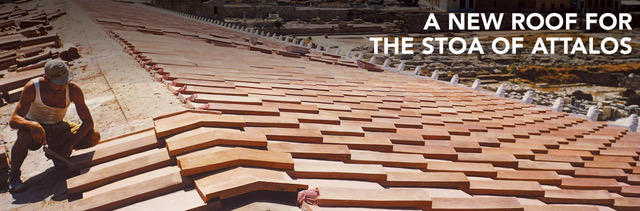
The American School of Classical Studies at Athens announces the Restoration of the Roof of the Stoa of Attalos
After 70 years, the Stoa of Attalos in the Athenian Agora is getting a new roof. Thanks to a generous $1.1 million grant from the Packard Humanities Institute, the American School of Classical Studies at Athens is undertaking an important project to preserve the Stoa of Attalos by restoring the roof of the building.
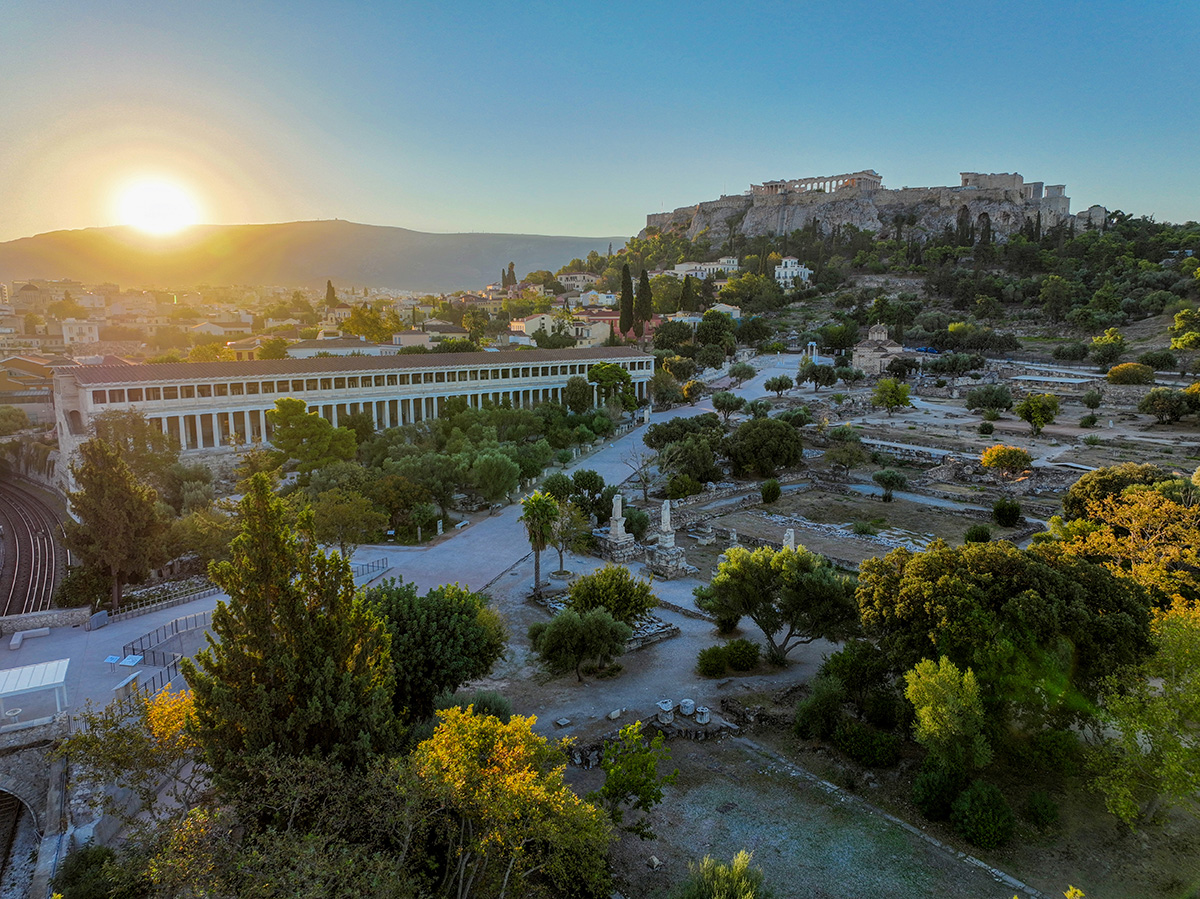
Since 1931, the American School of Classical Studies at Athens has conducted excavations in the ancient Athenian Agora, the civic center of ancient Athens and birthplace of democracy. The excavation area, now an archaeological park in the center of the modern city, is one of the most visited archaeological sites in Greece. The two-storied Stoa of Attalos, originally constructed in the 2nd century BC, was expertly reconstructed between 1953 and 1956 to serve as a museum and storage facility for the archaeological objects excavated at the site. The Stoa continues to fulfill this vital role today. It houses the Museum of the Ancient Agora, exhibition spaces, archaeological collections, storage facilities, offices, research spaces and the excavation archives. The decision to repair the roof follows a multi-year study of the Stoa’s facilities, storage capacity, and infrastructure.
With the signing of a Donation Agreement by Minister of Culture, Lina Mendoni, and the School’s Director, Bonna Wescoat, the project to repair the 2,300 sq. m. roof is ready to begin. The repair will include the careful removal of all tiles and other materials, waterproofing and restoration, and the reinstallation or replacement of custom-made tiles where necessary. All replacement materials will be certified and selected for their authenticity, durability and long service life. These interventions will ensure the long-term preservation and proper functioning of the building.
In the Ministry’s press release, Minister of Culture Lina Mendoni stated: “The protection and promotion of our cultural heritage is a constant priority for the Ministry of Culture. The Stoa of Attalos, one of the most important monuments of the Ancient Agora of Athens, is an integral part of the capital’s historical and archaeological character. The agreement we signed with the American School of Classical Studies ensures funding for the structural engineering study and all necessary work to repair and waterproof the roof. Our collaboration with the American School, an institution with a long history of scholarly engagement and contribution in Greece, is yet another example of a meaningful partnership for the protection of our cultural heritage. Our goal is to ensure the best possible protection of the monument and to preserve it for future generations.”
Bonna D. Wescoat, Director of the American School agrees: “The collaboration between the American School and the Ministry of Culture to restore the roof of the Stoa of Attalos is an honor for us. Since its reconstruction by the American School in the 1950s, this iconic monument has served its modern function as a museum, a gathering place, and a storage facility for finds from the excavations of the Athenian Agora. The Agora stands at the heart of the School’s mission as a center of archaeological research for generations of students and scholars. For several decades, this work has been generously underwritten by the Packard Humanities Institute, and we are once again grateful for its support in the restoration of the Stoa’s roof. The project affirms the School’s long-standing commitment to the Athenian Agora and its collaboration with the Ministry of Culture on projects across Greece.”
The excavations in the Agora mark a significant chapter in the history of the American School and continue to be one of our greatest contributions to the understanding and appreciation of ancient Greece. Each summer, the Agora trains university student volunteers in advanced archaeological techniques. The Agora supports some 200 scholars annually in their research. By safeguarding the Stoa of Attalos, we help ensure that this remarkable monument, the artifacts it protects, and the investigative spaces it affords will continue to serve future generations of students, researchers, and visitors.