Hesperia 94.4 Now Online!
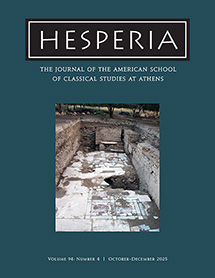
We are pleased to announce the publication of Hesperia 94.4! Topics in this issue include a new evaluation of the Kleidi Pass at Samikon, the latest field report from the Corinth Excavations campaign Northeast of the Theater, and a survey of the uninhabited islands of the western Cyclades.
Subscribers can read the issue online at Project MUSE, which now hosts current issues of Hesperia as well as an archive of past volumes dating to 2002. Hesperia remains on JSTOR as part of their Arts and Sciences II package, with the usual three-year moving wall. Additionally, all issues of Hesperia from 2011 and earlier are available as Open Access on our website. The printed version will be mailed shortly.
The “Thermopylai of the Peloponnese”: The Kleidi Pass at Samikon, by Birgitta Eder, Hans-Joachim Gehrke, Erofili-Iris Kolia, Lea Obrocki, and Andreas Vött, brings together for the first time all available archival material, the results of recent geoarchaeological and geophysical research, and a critical assessment of known literary sources to reappraise the ancient topography at the Kleidi Pass on the west coast of the Peloponnese where, based on Strabo’s description, the regionally important Sanctuary of Poseidon is thought to have been located. A plan of the area maps all recognizable structures on and adjacent to the Kleidi hills and offers the basis for a fresh evaluation of the site.
Corinth, 2022 and 2023: Northeast of the Theater, by Christopher A. Pfaff, details the 2022 and 2023 excavation seasons at Corinth focused on the southern part of the field northeast of the Theater. More of the “marble room” (perhaps the apodyterium of a Late Roman bath complex) was exposed, as were parts of two massive walls that appear to represent two later (6th-century?) building phases. A deep deposit of earth and debris yielded a variety of finds that support a 7th-century date for the abandonment and filling in of the room. Portions of the Roman cardo flanking the east side of the marble room were explored. Middle Byzantine walls were revealed to the east of the Byzantine road that succeeded the cardo.
A Regional Survey of the Uninhabited Islands of the Western Cyclades: The Small Cycladic Islands Project, 2021–2022, by Alex R. Knodell, Demetrios Athanasoulis, John F. Cherry, Magda Giannakopoulou, Evan I. Levine, Denitsa Nenova, Hüseyin Ç. Öztürk, and Zozi Papadopoulou, outlines the work of the Small Cycladic Islands Project (SCIP), a regional archaeological survey that investigated 87 small, currently uninhabited Aegean islands between 2019 and 2024. Fieldwork in 2021 and 2022 included comprehensive surveys of 14 islets around and between Kythnos, Seriphos, Siphnos, Kimolos, and Melos. Material culture from multiple periods was found on nearly every island. In addition to habitation, archaeological evidence was documented for numerous other forms of exploitation, including hunting, fishing, agriculture, pastoralism, mineral extraction, fortification, and surveillance. Comparative analysis indicates a strong correlation between the size of an island and the intensity of occupational history. Other factors, including natural resources, network centrality, and proximity to larger landforms, also influence histories of island occupation and use.
Click here to subscribe to Hesperia. In addition to receiving printed issues and online access to Hesperia, subscribers also receive complimentary online access to Hesperia Supplements, and Agora and Corinth volumes.
Hesperia welcomes submissions from scholars working on all aspects of Greek material culture, including archaeology, art, architecture, history, epigraphy, and related studies. Further information about the journal, including instructions for preparing manuscripts for submission, can be found on our website.
The Friends of Hesperia was founded in 2014 to help fund the journal's growth in all its manifestations. We invite you to become a member today and help support one of the most preeminent journals in the field of Mediterranean archaeology.