Hesperia 95.3 Is Now Online!
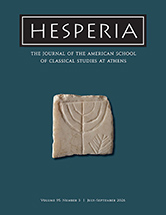
We are pleased to announce the publication of Hesperia 95.3! Topics in this issue include figs in the Late Bronze Age, hepatoscopy in visual art and text, Hellenistic graves at Notion, and a re-examination of the possible use of the Agora Metroon as a synagogue in Late Roman Athens.
Subscribers can read the issue online at Project MUSE, which now hosts current issues of Hesperia as well as an archive of past volumes dating to 2002. Hesperia remains on JSTOR as part of their Arts and Sciences II package, with the usual three-year moving wall. Additionally, all issues of Hesperia from 2011 and earlier are available as Open Access on our website. The printed version will be mailed shortly.
An Underrated Food Source: The Role of Figs (Ficus Carica L.) in Bronze Age Aegean Economies, by Catherine E. Pratt, seeks to fill a gap in research on Bronze Age agriculture by focusing on the humble fig. Using textual and archaeological data from the Minoan and Mycenaean palatial eras, the article better illustrates the role of figs in Late Bronze Age Aegean cultures. Linear A and B tablets demonstrate that figs were an integral part of the broader Bronze Age palatial economies, while archaeological records illustrate that figs were prominent components of household, palatial, and ritual contexts. Together, these elements show definitively that figs were a staple good alongside wheat, barley, olives, and grapes.
Looking at Livers: Hepatoscopy in Greek Images and Texts, by Luisa Balandat, takes the fragments of an Attic black-figure neck amphora in Bonn as a starting point for general considerations on the prevalence of hepatoscopy in ancient Greece. Despite abundant studies on this divinatory practice that involves the examination of a sacrificial animal’s liver, the evidence for its popularity during the Archaic and Classical periods remains sparse. A critical analysis of the few relevant literary texts demonstrates that they are vague and sometimes misread. Against this back¬ground, the long-standing theory that Attic vases depicting hepatoscopy were targeted at Etruscan customers is examined in detail for the first time. Given the paucity of texts and the lack of further images, it is proposed that the custom’s importance in pre-Roman Greece has been overestimated.
A Hellenistic Grave Assemblage from Notion: Revisiting the Sepulchral Landscape of an Ionian City, by Christina DiFabio, presents an assemblage of finds from a rock-cut tomb excavated in 1907 by Théodore Macridy outside the ancient Ionian city of Notion. Macridy worked on behalf of the Imperial Museum of the Ottoman Empire and published the objects, including gold jewelry and terracotta figurines, as well as a grave stele discovered nearby. Some finds were accessioned and are now housed in the Istanbul Archaeological Museum. Individual objects have been studied, but the grave assemblage has never been examined as a whole since its original publication. This article dates the assemblage to the Late Hellenistic–Early Roman Imperial period, proposes that the tomb was for a local elite woman, and contextualizes the tomb within Notion’s necropoleis.
The Agora Metroon in Late Roman Athens: A Reexamination of Its Use as a Synagogue, by Jocelyn Burney, revisits a fragment of Pentelic marble incised with a menorah and lulav that was discovered in 1933 near the Hellenistic Metroon on the west side of the Athenian Agora. Homer A. Thompson proposed that the fragment had originally adorned the Metroon, the northernmost room of which was rebuilt as a basilica-plan hall during the 4th or 5th century CE. This article reevaluates Thompson’s theory, beginning with the marble fragment, which may have come from a funerary marker, followed by the reconstruction of the Metroon, which is dated to the early 5th century. Ultimately it is found that the fragment cannot be connected to the Metroon based on stratigraphy, and there is no positive evidence that the building was a synagogue.
Click here to subscribe to Hesperia. In addition to receiving printed issues and online access to Hesperia, subscribers also receive complimentary online access to Hesperia Supplements, and Agora and Corinth volumes.
Hesperia welcomes submissions from scholars working on all aspects of Greek material culture, including archaeology, art, architecture, history, epigraphy, and related studies. Further information about the journal, including instructions for preparing manuscripts for submission, can be found on our website.
The Friends of Hesperia was founded in 2014 to help fund the journal's growth in all its manifestations. We invite you to become a member today and help support one of the most preeminent journals in the field of Mediterranean archaeology.